

Perovskite-silicon tandem solar cells have become a global research hotspot in advanced photovoltaics due to their potential of surpassing the Shockley-Queisser theoretical limit efficiency of single-junction solar cells. Traditional single-junction silicon solar cells face efficiency bottlenecks from thermal relaxation losses of short-wavelength photons. To address this issue, researchers propose integrating wide-bandgap perovskites with silicon to construct tandem solar cells, effectively reducing carrier thermalization losses and maximizing solar energy utilization for breakthrough power conversion efficiency. Tandem solar cells are widely recognized as the next generation of ultra-efficient photovoltaic technology.
In recent years, there has been considerable advancement in perovskite-silicon tandem solar cells. However, the wide-bandgap perovskite sub-cells still suffer from serious interfacial non-radiative recombination, primarily including the recombination at the interface between the surface of the perovskite layer and the electron transport layer (ETL), as well as the recombination caused by inadequate conformality and non-uniform coverage of the hole transport layer (HTL) on textured substrates.
In September 2024, LONGi’s tandem research team published a landmark study in Nature. By exploiting the nanoscale discretely distributed lithium fluoride ultrathin layer followed by an additional deposition of diammonium diiodide molecules, the researchers have devised a bilayer-intertwined passivation strategy that combines efficient electron extraction with further suppression of non-radiative recombination. This breakthrough elevated the efficiency of perovskite-silicon tandem cells to reach up to 33.9%, which represents the first reported certified efficiency of a two-junction tandem solar cell exceeding the single-junction Shockley–Queisser limit of 33.7%. This work is a milestone achievement in photovoltaics.
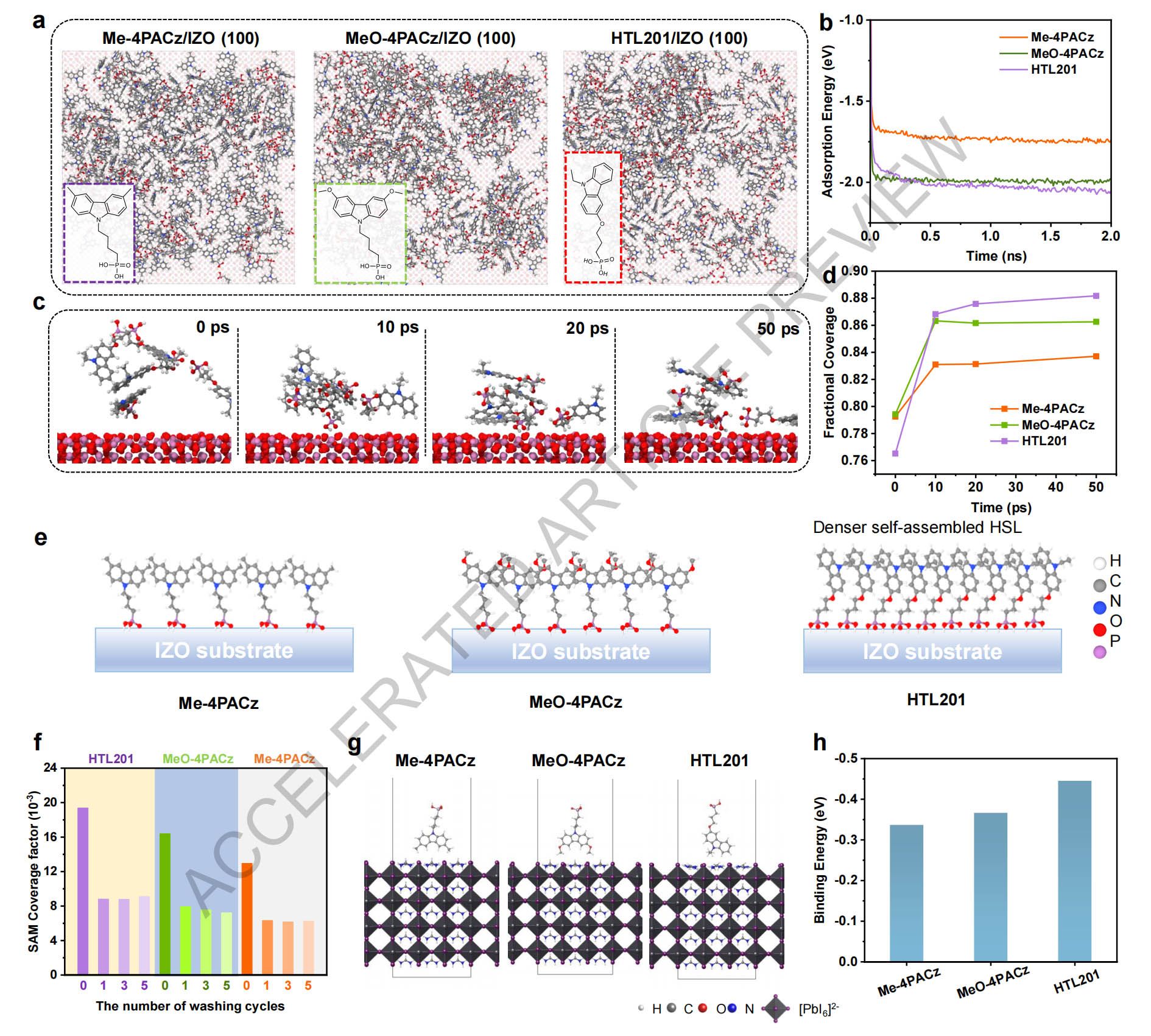
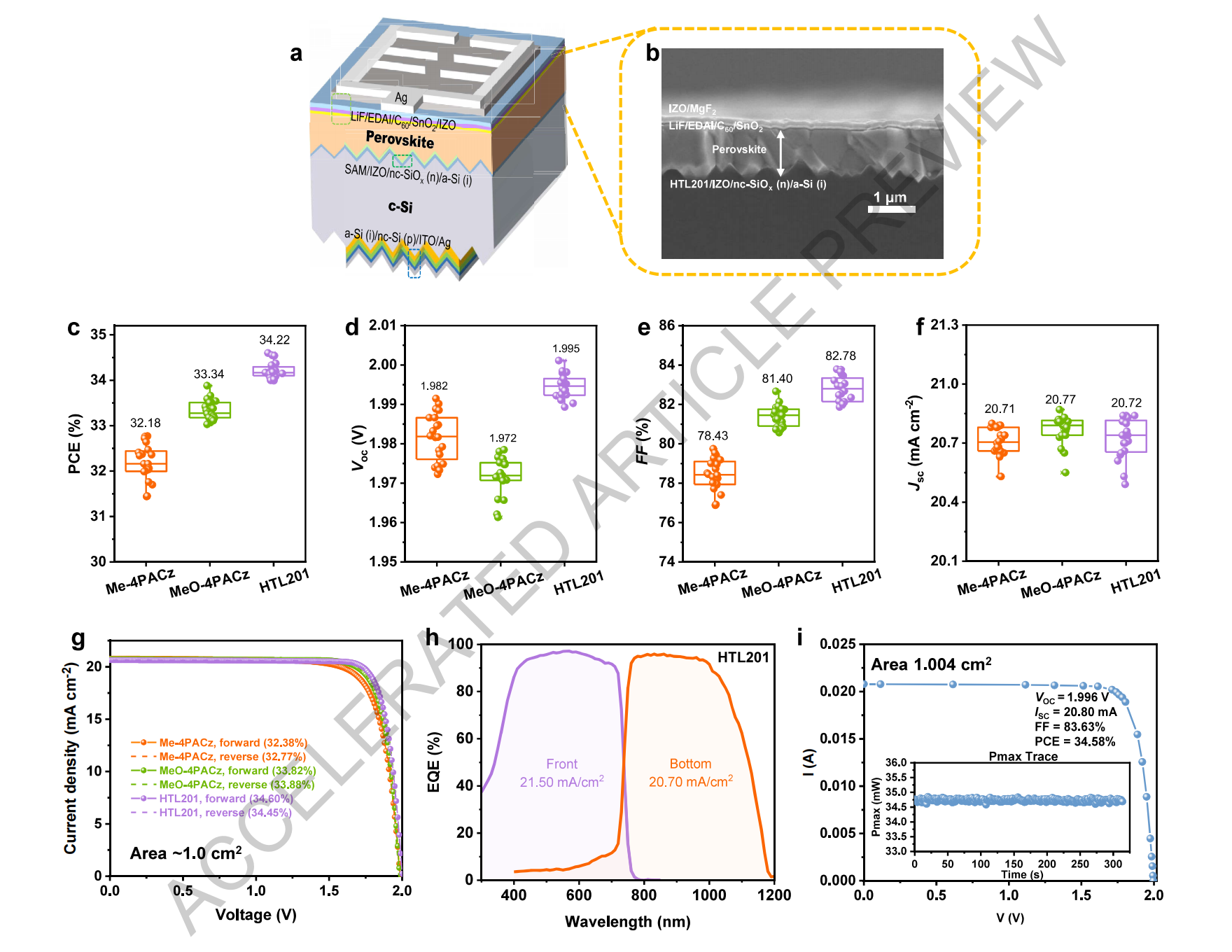
Addressing the non-radiative recombination at the buried interface, LONGi's research team collaborated with Soochow University to achieve breakthrough progress in novel organic self-assembled molecule (SAM) design and perovskite-silicon tandem devices. Different from most reported carbazole-based SAMs, which feature a symmetric molecular structure with nitrogen atoms bonded to phosphonic acid anchoring groups, LONGi researchers constructed an asymmetric carbazole-based SAM (HTL201) that incorporates spacers and anchoring phosphonic acid groups flanking the phenyl ring of the carbazole core, serving as a hole-selective layer in perovskite-silicon solar cells.
The asymmetric configuration of HTL201 enable improved coverage and uniformity on textured silicon substrates while optimizing interfacial energy level alignment. Concurrently, the strong coordination interaction between HTL201 and perovskite film effectively reduces non-radiative recombination at buried interface.
By integrating HTL201 with double-side-textured heterojunction silicon bottom cells, the team successfully fabricated perovskite-silicon tandem solar cells with an impressive voltage of nearly 2 V, resulting in a certified power conversion efficiency (PCE) of up to 34.6%. This research provides critical technical solutions for developing novel SAM materials and further advancing silicon-perovskite tandem efficiency.
This work was published in Nature on 7 July 2025 under the title "Efficient perovskite/silicon tandem with asymmetric self-assembly molecule". This study represents a fundamental advancement in interfacial engineering for ultra-high-efficiency photovoltaics.
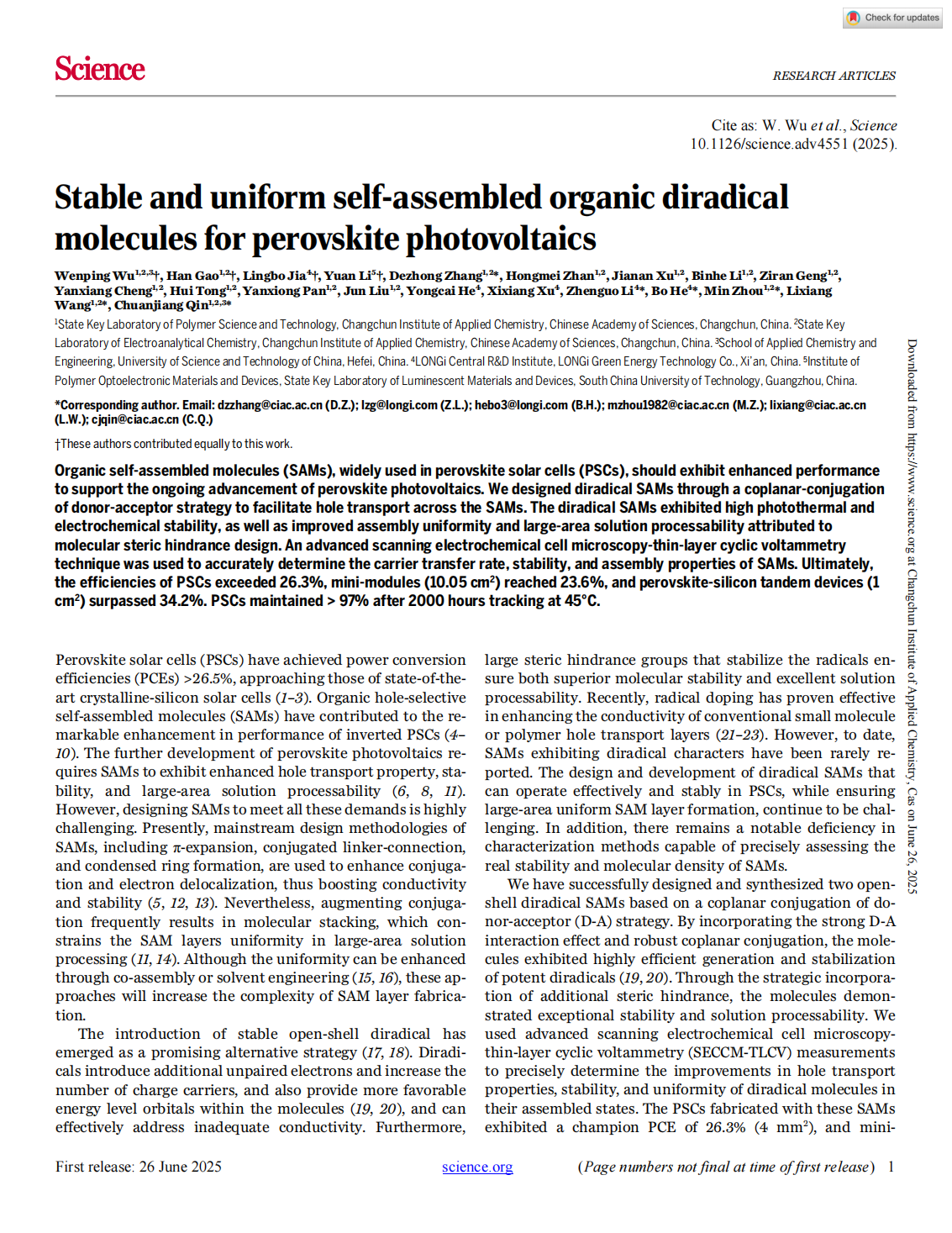
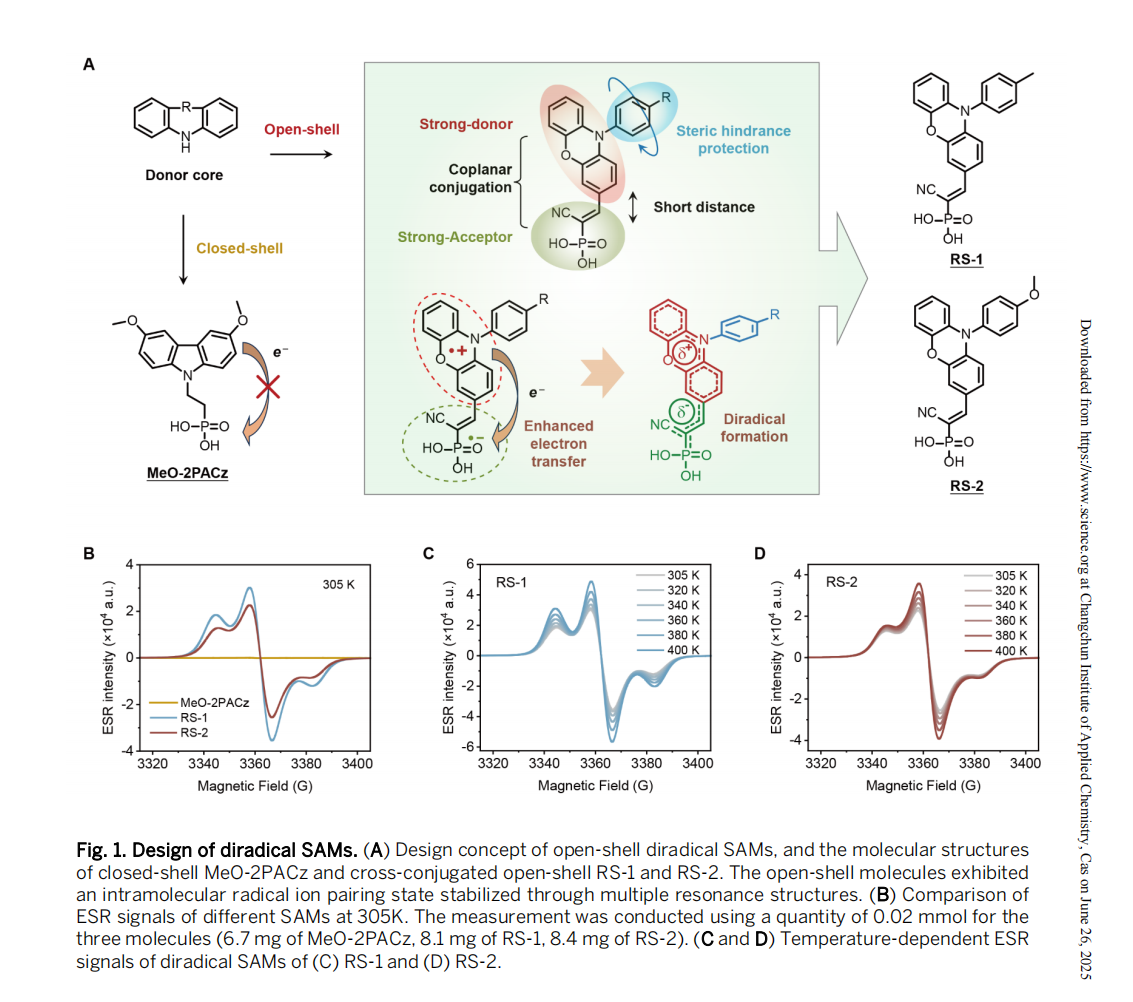
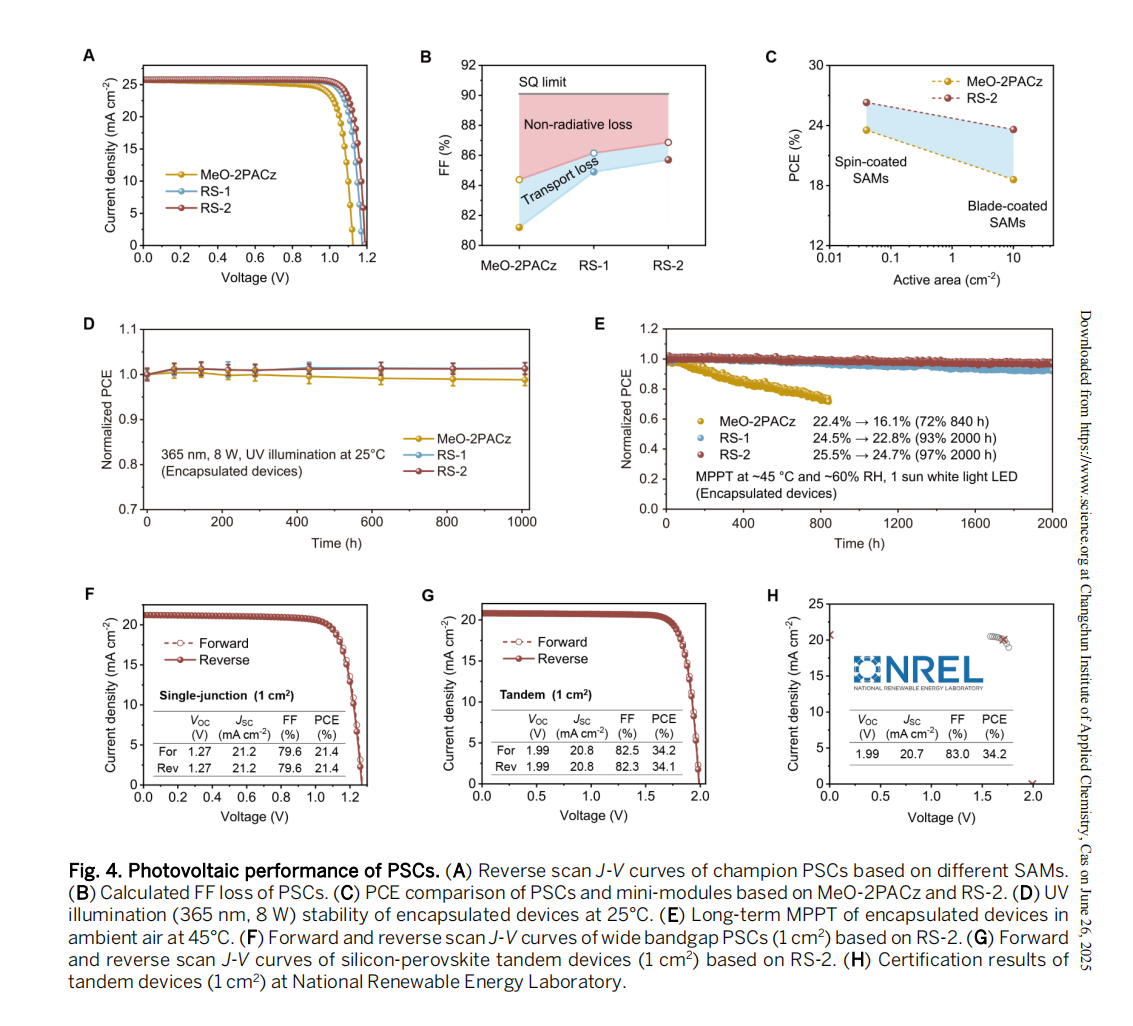
Shortly before this breakthrough, LONGi collaborated with the Changchun Institute of Applied Chemistry, Chinese Academy of Sciences, and other research teams to develop diradical SAMs through a coplanar-conjugation of donor-acceptor strategy. This material exhibits exceptional carrier transport properties, remarkable structural stability under practical operating conditions, and superior assembly uniformity, enabling significant advancements in both efficiency and stability for perovskite solar cells. The related research findings were published in Science on 26 June 2025 under the title "Stable and uniform self-assembled organic diradical molecules for perovskite photovoltaics".
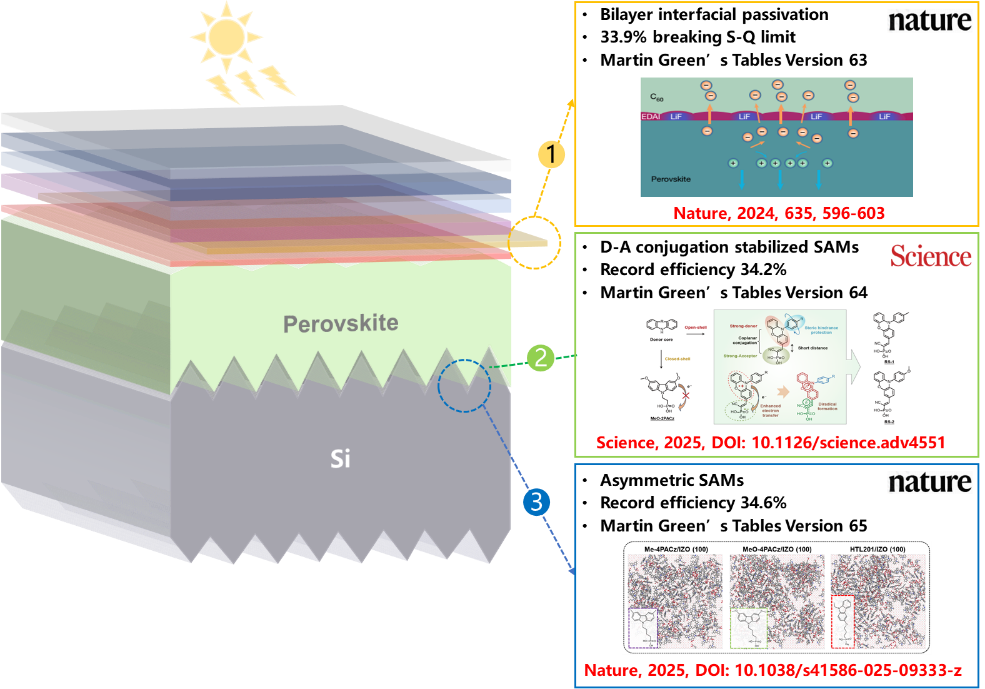
Thus far, LONGi's tandem research team has disclosed three core innovations to the global PV industry through publications in top-tier journals, corresponding to their world-record efficiencies of 33.9%, 34.2%, and 34.6% (included in Versions 63, 64, and 65 of Martin Green's Solar Cell Efficiency Tables respectively): Bilayer interdigitated passivation strategy for top interfaces, Donor-acceptor (D-A) conjugated stable SAMs, Asymmetric SAM-type hole transport materials.
This series of publications demonstrates LONGi's industry-academia collaboration model with institutions including Soochow University and the Changchun Institute of Applied Chemistry, Chinese Academy of Sciences. By addressing critical technological challenges through coordinated innovation, the team is making substantial contributions to building China's integrated tandem cell ecosystem—bridging industry, academia, research, and application for sustainable advancement.
About LONGi
Founded in 2000, LONGi is committed to being the world’s leading solar technology company, focusing on customer-driven value creation for full scenario energy transformation.
Under its mission of 'making the best of solar energy to build a green world', LONGi has dedicated itself to technology innovation and established five business sectors, covering mono silicon wafers cells and modules, commercial & industrial distributed solar solutions, green energy solutions and hydrogen equipment. The company has honed its capabilities to provide green energy and has more recently, also embraced green hydrogen products and solutions to support global zero carbon development.
More details here: www.longi.com/