

Recently, Li Zhenguo, founder and Chief Technology Officer of LONGi, published a forward-looking perspective article titled "Photovoltaics for food security" in the international top-tier academic journal Nature Sustainability. The article systematically elaborates on the significant potential of photovoltaic (PV) technology to enhance the resilience of global food supply and proposes two promising technological pathways, demonstrating the vital role of PV in supporting global sustainable development beyond energy transition.
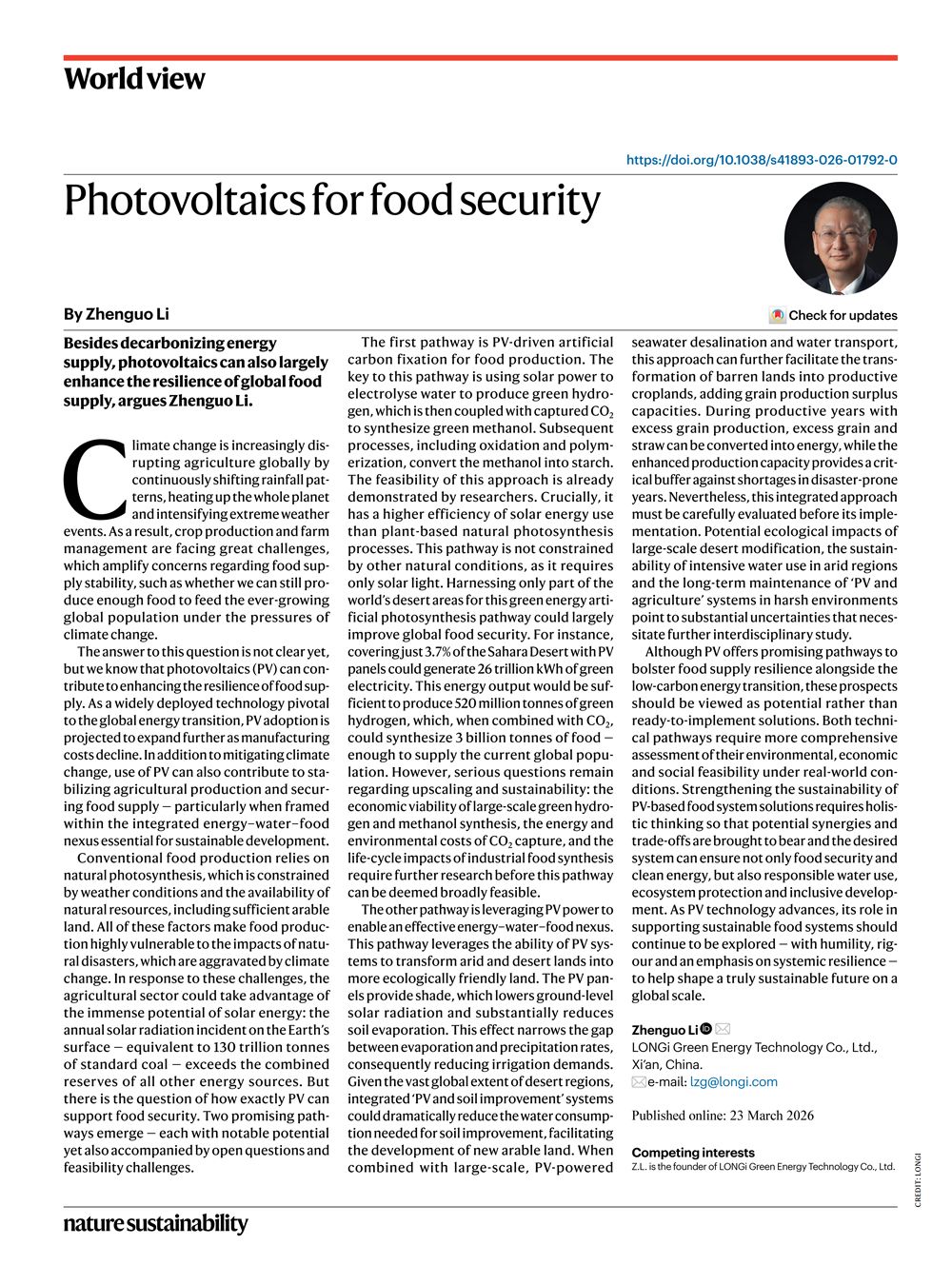
In the article, Li Zhenguo points out that traditional food production is highly dependent on natural photosynthesis and climatic conditions, making it significantly vulnerable to extreme weather events such as droughts and floods. Against the backdrop of intensifying global climate change, agricultural production faces increasingly severe challenges, and the stability of food supply has become a common concern of the international community. As a crucial force in the global energy transition, PV technology not only plays a key role in reducing carbon emissions but also holds promise for providing innovative solutions to enhance food supply resilience.
The article elaborates on two technological pathways through which PV technology can support food supply assurance:
First, the PV-driven synthetic starch pathway from carbon dioxide. This pathway utilizes PV-generated electricity for water electrolysis to produce green hydrogen, which is then coupled with captured carbon dioxide to synthesize green methanol, subsequently converted into starch through processes such as oxidation and polymerization. Compared to traditional natural photosynthesis, this pathway offers higher solar energy utilization efficiency and is not constrained by natural conditions such as land and climate. The article estimates that deploying PV on just 3.7% of the Sahara Desert's area could generate 26 trillion kilowatt-hours of green electricity, sufficient to produce 520 million tons of green hydrogen, which could then synthesize 3 billion tons of food, meeting the global population's food needs.
Li Zhenguo emphasizes that while this pathway has been validated at the laboratory level, its large-scale economic viability, the energy consumption and environmental impact of carbon dioxide capture, and the full lifecycle assessment of industrial food synthesis still require further research.
Second, the PV-driven "energy-water-food" synergistic system pathway. This pathway leverages the multifunctional attributes of PV systems. By constructing PV power plants in desert areas, the shading effect of PV modules reduces surface radiation and decreases soil water evaporation, thereby improving the soil microclimate and reducing irrigation needs. Combined with PV-driven seawater desalination and cross-regional water transport projects, this pathway can gradually transform previously uncultivable desert land into arable farmland, enhancing food production reserve capacity. In years of bumper harvests, surplus grain and straw can be converted into energy; in years of disasters, the newly added arable land can serve as a critical buffer for food supply.
Li Zhenguo notes that while this pathway achieves land improvement and increased food production, it also requires careful assessment of the ecological impacts of large-scale desert transformation, the sustainability of intensive water resource utilization in arid regions, and the long-term operational reliability of "PV + agriculture" systems in harsh environments. These uncertainties still need to be clarified through interdisciplinary research.
As the founder and Chief Technology Officer of LONGi, Li Zhenguo has long been committed to driving sustainable development through technological innovation. His perspective article in Nature Sustainability systematically expounds on the possibility of constructing a more resilient global sustainable development system through the deep integration of PV technology with ecology, agriculture, water resources, and other fields.
Click to see the full article here: https://www.nature.com/articles/s41893-026-01792-0
About LONGi
Founded in 2000, LONGi (Stock code: 601012. SH) is committed to being the world's leading solar technology company, focusing on customer-driven value creation for full scenario energy transformation.
Under its mission of 'making the best of solar energy to build a green world', LONGi has dedicated itself to technology innovation and established several business sectors, covering mono silicon wafers, cells and modules, commercial & industrial distributed solar solutions, green energy solutions, building integrated photovoltaic and hydrogen equipment. As an international company, LONGi's business covers more than 160 countries and regions. Actively practicing its "Solar for Solar" concept, LONGi is accelerating the global transition to sustainable energy and promoting energy equity, enabling more people around the world to access affordable clean energy.
More details here: www.longi.com/