

Kayapó Connection: A coalition of Brazilian companies and LONGi’s support drives sustainable transformation in Indigenous lands through renewable energy, internet access, healthcare, environmental protection, and respect for ancestral culture.
The Indigenous Lands of the Brazilian Amazon are environmental strongholds, vital for biodiversity conservation. However, these regions face historic challenges in accessing basic services. Often described as "green islands," they are under constant threat from deforestation, illegal mining, and social exclusion.
According to the Kabu Institute, around 79,000 Indigenous people in the Legal Amazon still live without access to electricity, relying primarily on diesel generators — which are polluting, noisy, and difficult to maintain. Broadband internet is also scarce, limiting access to education, healthcare, and income generation. On top of that, federal funding for Indigenous healthcare has been reduced by nearly 20% in recent years, further exacerbating the vulnerability of these populations.
Solar energy as a turning point: the Kayapó Connection Project is born
In response, the Kayapó Connection Project emerged — an innovative initiative that brings together companies, social organizations, and Indigenous communities in a joint mission to bring renewable energy, connectivity, and essential services to local villages. The goal is to reduce structural inequalities, strengthen Indigenous autonomy, and create a new model of sustainable development aligned with environmental protection and respect for ancestral cultures and lifestyles.
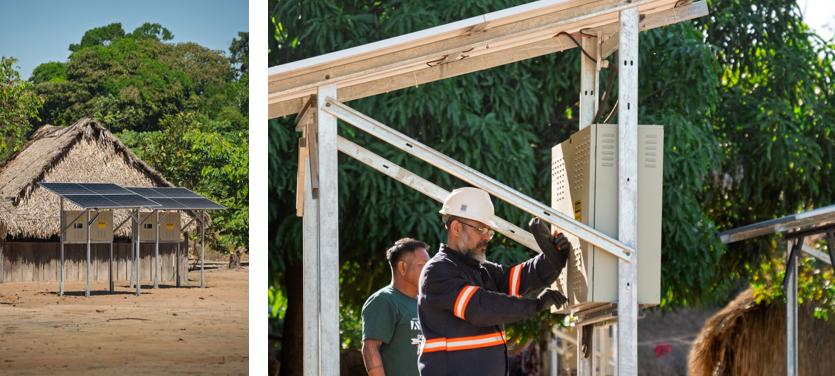
Since November 2024, homes, school, health post, and the community center in the Pykany village of the Kayapó people have been powered by solar energy stored in batteries, replacing the old diesel generators.
A sustainable and efficient solution: solar energy with storage
A total of 35 Individual Energy Generation Systems with Intermittent Sources (SIGFI) were installed, comprising photovoltaic modules and batteries. LONGi, a global leader in solar technology, contributed with 100 Hi-MO series solar modules through its international “Solar for All” program. The batteries were provided by Baterias Moura, ensuring energy autonomy in a region outside the national power grid.
The solution, implemented by Comerc Energia and MicroPower, is also supported by the Aya Institute, Kabu Institute, and the A Gente Transforma Institute. Together, these organizations delivered infrastructure without the need for deforestation for power lines and with low maintenance requirements.
Energy brings autonomy: impacts on women and village life
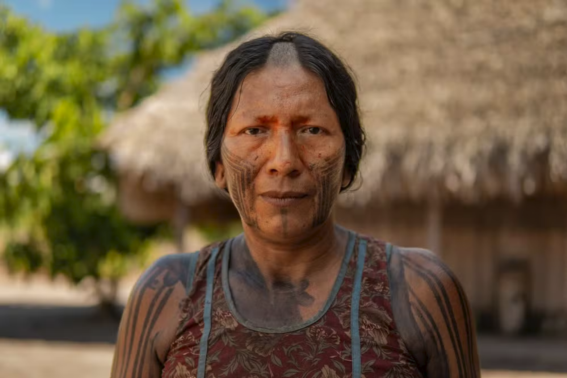
With continuous access to energy, women in the village gained more time and safety for economic and social activities. “Before, we had to cut firewood, carry it ourselves, and light a fire inside the house to have light. That caused many respiratory problems,” says Iretynh Kayapó, coordinator of the Menire project, focused on women’s income generation. “Today, we can make handicrafts at night and rest more during the day.”
The men of the village have also reduced the time spent on hunting and fishing, making room for new economic ventures, such as a rice processing unit and cocoa cultivation and sales.
Technology supporting health, safety, and education
The arrival of energy also brought connectivity, revolutionizing access to healthcare, education, and territorial security. Real-time communication systems are now possible, crucial for monitoring and protecting over 10 million hectares of forest — an area larger than Portugal.
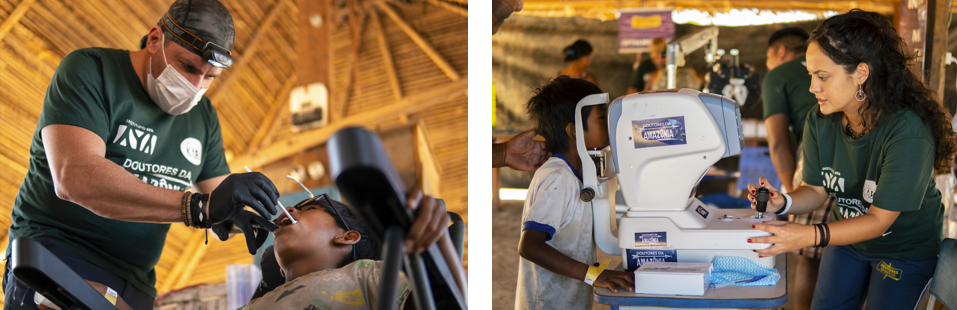
Thanks to the solar network, NGOs like Doutores da Amazônia can now deliver more efficient medical and dental care. Connectivity also enables the use of artificial intelligence and telemedicine, accelerating diagnoses, referrals, and increasing the frequency of services — one of the main gaps in Indigenous healthcare.
A replicable model
More than an electrification project, Kayapó Connection is a model of social and environmental transformation. It combines cutting-edge technology with traditional wisdom, promoting social justice and expanding the Indigenous communities’ ability to manage their own lands.
LONGi is proud to be part of this coalition, alongside clients and partners, contributing high-performance technology in humanitarian contexts. The initiative reinforces the company’s commitment to the UN Sustainable Development Goals and the global democratization of clean energy.
Note: This report includes references from articles by Naiara Bertão, published in Valor Econômico and Um Só Planeta, following a site visit organized by Comerc Energia. Photos by Matheus Melo.
About LONGi
Founded in 2000, LONGi (Stock code: 601012. SH) is committed to being the world's leading solar technology company, focusing on customer-driven value creation for full scenario energy transformation.
Under its mission of 'making the best of solar energy to build a green world', LONGi has dedicated itself to technology innovation and established several business sectors, covering mono silicon wafers, cells and modules, commercial & industrial distributed solar solutions, green energy solutions, building integrated photovoltaic and hydrogen equipment. As an international company, LONGi's business covers more than 160 countries and regions. Actively practicing its "Solar for Solar" concept, LONGi is accelerating the global transition to sustainable energy and promoting energy equity, enabling more people around the world to access affordable clean energy.
More details here: www.longi.com/